Raised pattern
Checkered Steel Plate Weight: Pattern Allowance, Formula & Chart
base plate + pattern mass
Checkered plate weight is the base plate plus the raised pattern. The pattern adds a fixed mass per square metre, not a fixed percentage of the base.
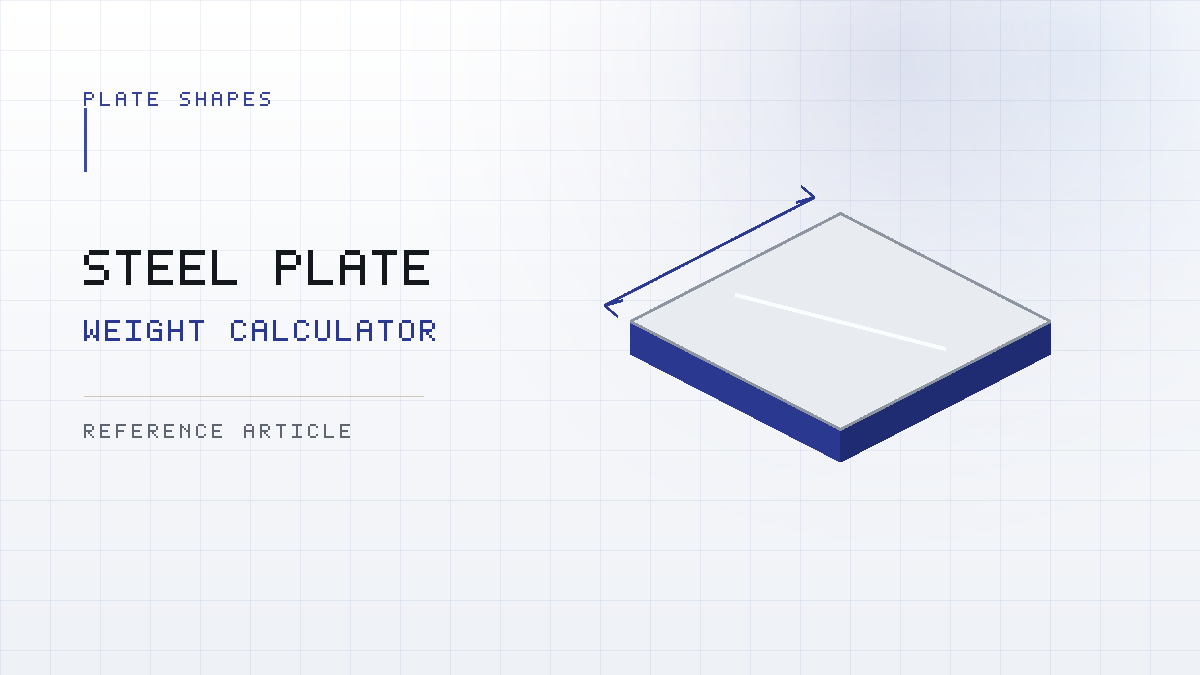
Checkered steel plate weight is the weight of the flat base plate plus the mass of the raised pattern rolled onto its surface. The base plate is calculated exactly as any plain plate is, from the base thickness, and the pattern is added separately. The pattern adds a roughly constant mass per unit area, not a constant percentage, which is why the widely quoted “add 5%” and “add 10%” rules are wrong at most thicknesses.
How much the pattern adds depends on which pattern it is. Published figures run from about 2 kg/m² for a light European tear pattern to about 5 kg/m² for the heavier North American diamond tread. Take the number from the product data for the plate you are actually buying.
What checkered plate is
Checkered plate, also called chequered plate, tread plate, floor plate or diamond plate, is hot-rolled steel with raised figures rolled into one face at regular intervals. The raised figures give a slip-resistant walking surface, which is what it is mostly used for: walkways, stair treads, platforms, vehicle decks and access covers.
The underside is flat. The pattern is on one face only, and it is formed during rolling rather than applied afterwards, so it is the same steel as the plate.
In North America the product is covered by ASTM A786/A786M, Standard Specification for Hot-Rolled Carbon, Low-Alloy, High-Strength Low-Alloy, and Alloy Steel Floor Plates. In Europe, patterned steel is produced to DIN 59220 and related standards. Notably, EN 10029 excludes chequer plate from its scope explicitly, so the ordinary plate tolerance classes do not apply to it.
The thickness on the order is the base thickness
This is the convention that causes most of the confusion.
When checkered plate is specified as 5 mm or as 1/4 in, that figure is the base thickness, the flat part of the plate below the pattern. It is not the overall height including the raised figures.
Overall height is base thickness plus pattern height, and pattern height is a separate dimension in the product data. A 5 mm plate with a 2 mm pattern measures 7 mm across a raised figure and 5 mm between them. Measuring a delivered plate with a caliper across a diamond and comparing it with the order is how people convince themselves they have been sent the wrong material.
Keep three numbers separate: base thickness, pattern height, and mass per square metre. Only the first and third go into a weight calculation.
The formula
Two terms, added:
m_base    = area × base thickness × density
m_pattern = area × pattern mass per unit area
m_total   = m_base + m_pattern
In metric, with area in m², base thickness in mm and pattern mass in kg/m²:
m = A × (t × 7.85 + p)In imperial, with area in ft², base thickness in inches and pattern mass in lb/ft²:
m = A × (t × 40.833 + p)The base term is ordinary plate arithmetic and can be run straight through the Steel Plate Weight Calculator using the base thickness. The pattern term is a lookup, and that is the part worth getting right.
Published pattern allowances
Two independent sources, working in different units, tell the same story.
SSAB publishes its method for patterned steel directly: calculate the base steel weight at 7.85 kg/dm³, then add the pattern weight, given as approximately 2 kg/m² for Tear Pattern T (European tear), and approximately 4 kg/m² for Tear Pattern A (American tear) and for Chequer Pattern R.
A North American service centre floor plate table gives weights per square foot for each base thickness. Subtract the plain plate weight at 490 lb/ft³ from each published floor plate figure and the pattern allowance falls out:
| Base thickness | Plain plate (lb/ft²) | Floor plate (lb/ft²) | Pattern adds (lb/ft²) | Pattern adds (kg/m²) | As a percentage |
|---|---|---|---|---|---|
| 14 gauge | 3.05 | 3.75 | 0.700 | 3.42 | +22.9% |
| 1/8 in | 5.10 | 6.16 | 1.056 | 5.16 | +20.7% |
| 3/16 in | 7.66 | 8.71 | 1.054 | 5.14 | +13.8% |
| 1/4 in | 10.21 | 11.26 | 1.052 | 5.13 | +10.3% |
| 5/16 in | 12.76 | 13.81 | 1.050 | 5.12 | +8.2% |
| 3/8 in | 15.31 | 16.37 | 1.058 | 5.16 | +6.9% |
| 1/2 in | 20.42 | 21.47 | 1.053 | 5.14 | +5.2% |
| 5/8 in | 25.52 | 26.58 | 1.059 | 5.17 | +4.2% |
| 3/4 in | 30.62 | 31.68 | 1.055 | 5.15 | +3.4% |
| 1 in | 40.83 | 41.89 | 1.057 | 5.16 | +2.6% |
Read the two right-hand columns together. Across a range where the base thickness increases eightfold, the pattern adds a near-constant 1.05 lb/ft² (about 5.15 kg/m²), while the percentage falls from 20.7% to 2.6%.
The 14 gauge row is a useful anomaly. Its allowance is 0.700 lb/ft², not 1.05, because the lighter gauge product carries a lighter pattern. One supplier’s own range can contain more than one pattern.
Why a percentage allowance fails
Take the same table and test the two rules of thumb that circulate.
| Base thickness | “Add 5%” error | “Add 10%” error |
|---|---|---|
| 1/8 in | −13.0% | −8.9% |
| 3/16 in | −7.7% | −3.3% |
| 1/4 in | −4.8% | −0.3% |
| 3/8 in | −1.8% | +2.9% |
| 1/2 in | −0.2% | +4.6% |
| 3/4 in | +1.5% | +6.3% |
| 1 in | +2.4% | +7.2% |
Neither rule is right anywhere except by accident. The 5% rule happens to land on 1/2 in and the 10% rule happens to land on 1/4 in, and both are badly wrong at the ends of the range.
The reason is structural. The pattern is a fixed volume of steel standing on the surface, so its mass depends on the pattern geometry and the area covered, not on how thick the plate underneath it is. Adding a percentage makes the pattern mass scale with base thickness, which is not what the pattern does.
Add an absolute mass per unit area, taken from the product data for your pattern. That is the correct form of the allowance, and it is the form both published sources use.
Worked example: metric checkered plate
Known values: chequer pattern floor plate, 5 mm base thickness, 1500 × 3000 mm, carbon steel at 7,850 kg/m³, pattern allowance 4 kg/m² from the manufacturer’s data.
area      = 1.5 × 3.0 = 4.50 m2
base mass = 4.50 × 5 × 7.85 = 176.63 kg
pattern   = 4.50 × 4        = 18.00 kg
total     = 194.63 kg (429.1 lb)
Result: 194.63 kg. Interpretation: calculating the flat plate alone gives 176.63 kg and understates the plate by 18.00 kg, which is 9.2% of the true figure. Reverse check: total mass per square metre is 5 × 7.85 + 4 = 43.25 kg/m², and 43.25 × 4.50 = 194.63 kg.
Worked example: the same pattern on different base thicknesses
Known values: the same 4 kg/m² pattern, applied across the metric base thickness range.
| Base thickness | Base (kg/m²) | With pattern (kg/m²) | Pattern as % of base |
|---|---|---|---|
| 3 mm | 23.55 | 27.55 | +17.0% |
| 4 mm | 31.40 | 35.40 | +12.7% |
| 5 mm | 39.25 | 43.25 | +10.2% |
| 6 mm | 47.10 | 51.10 | +8.5% |
| 8 mm | 62.80 | 66.80 | +6.4% |
| 10 mm | 78.50 | 82.50 | +5.1% |
| 12 mm | 94.20 | 98.20 | +4.2% |
Interpretation: the allowance in kilograms per square metre never changes. The percentage changes by a factor of four across the range. Any percentage rule chosen from the middle of this table is wrong at both ends.
Worked example: imperial floor plate
Known values: 1/4 in base floor plate, 48 × 96 in sheets, 100 off. Published floor plate weight 11.26 lb/ft².
area per sheet = 48 × 96 ÷ 144 = 32 ft2
plain 1/4 in   = 0.25 × 40.833 × 32 = 326.7 lb
floor plate    = 11.26 × 32         = 360.3 lb
Result: 360.3 lb per sheet, 33.7 lb more than the plain plate. Interpretation: across 100 sheets that is 3,365 lb (1,526 kg) of steel that a flat-plate calculation would have missed, on an order the calculator would otherwise have put at 32,667 lb. Reverse check: 33.65 ÷ 32 ft² = 1.052 lb/ft², matching the derived allowance.
Getting the right pattern figure
Four ways, in descending order of reliability.
The manufacturer’s product data. Mills and rollers publish mass per square metre or per square foot for each pattern they roll. This is the best available number and it is usually a single table.
The supplier’s stock list. Service centres publish weights per sheet for the sizes they hold. Derive the allowance by subtracting the plain plate weight, as the table above does, and check that it stays constant across thicknesses. If it does not, the range contains more than one pattern.
A weighed sample. If a plate is on site, weigh a known area and subtract the calculated base weight. This settles it for that plate.
A stated assumption. If none of the above is available, use a published figure for a comparable pattern, write the assumption on the quotation, and flag it. An assumption that is visible can be corrected. One that is buried cannot.
What does not work is measuring the overall height across a raised figure and calculating a solid plate at that thickness. The pattern covers a fraction of the surface, so that method overstates the weight substantially.
Where checkered plate estimates go wrong
Using the overall height as the thickness. A 5 mm plate with a 2 mm pattern is not a 7 mm plate. Treating it as one overstates the mass by roughly 30%.
Applying a percentage allowance. Covered above. It is the single most common error, and its size depends on the thickness you happen to be working at.
Assuming the pattern is on both faces. Standard checkered plate has a flat underside. Double-sided patterned product exists, but it is a different item and carries a different allowance.
Carrying an allowance from one pattern to another. European tear at about 2 kg/m² and North American diamond at about 5 kg/m² differ by more than a factor of two. The word “checkered” on the order does not identify which one you are getting.
Expecting plate tolerance classes to apply. EN 10029 excludes chequer plate from its scope, so the class A to D thickness tolerances described in the EN 10029 guide do not govern it. Patterned steel has its own dimensional standards, and the base thickness tolerance should be confirmed with the supplier.
On top of all this, the ordinary reasons a delivered plate differs from its calculated weight still apply, and theoretical versus actual steel plate weight covers those.
Checkered plate weight FAQs
How do I calculate the weight of checkered plate? Calculate the flat base plate from its base thickness, then add the pattern mass. In metric, mass per square metre is the base thickness in millimetres multiplied by 7.85, plus the pattern allowance in kilograms per square metre from the product data.
How much does the pattern add? Published figures run from about 2 kg/m² for a light European tear pattern to about 5 kg/m² for the heavier North American diamond tread. It is an absolute figure per unit area, so it is a large percentage on thin plate and a small one on thick plate.
Is the quoted thickness the base or the overall height? The base. The raised figures stand above it, and pattern height is given separately in the product data.
Can I just add 10% to a plain plate calculation? Not reliably. Against one published floor plate range, a 10% allowance is 8.9% light at 1/8 in and 7.2% heavy at 1 in. Use an absolute allowance per unit area instead.
What is the difference between checker plate, chequer plate and diamond plate? They are regional names for the same class of product: hot-rolled plate with raised figures on one face. The pattern geometry behind the name varies by manufacturer and region, and so does the mass it adds.
Two terms, added carefully
Checkered plate is a flat plate with something extra on it, and the arithmetic should be written that way: a base term you calculate, plus a pattern term you look up. Keeping them separate makes the estimate checkable and makes it obvious which half of it is an assumption.
Put the base thickness and the sheet dimensions into the Steel Plate Weight Calculator for the first term, then add the pattern allowance from your supplier’s data for the second.
Pattern allowance figures in this article are drawn from published mill data for patterned steel, which gives approximately 2 kg/m² for a European tear pattern and approximately 4 kg/m² for American tear and chequer patterns, and from a published North American floor plate weight table from which the 1.05 lb/ft² allowance is derived here by subtraction. Product scope for hot-rolled floor plate is covered by ASTM A786/A786M.
Hexagonal Plate Weight & Custom-Shape Calculations
measure, split, subtract
Hexagonal plate weight follows from the across-flats dimension, while irregular profiles get split or taken from CAD. The area for each, and how to use it.
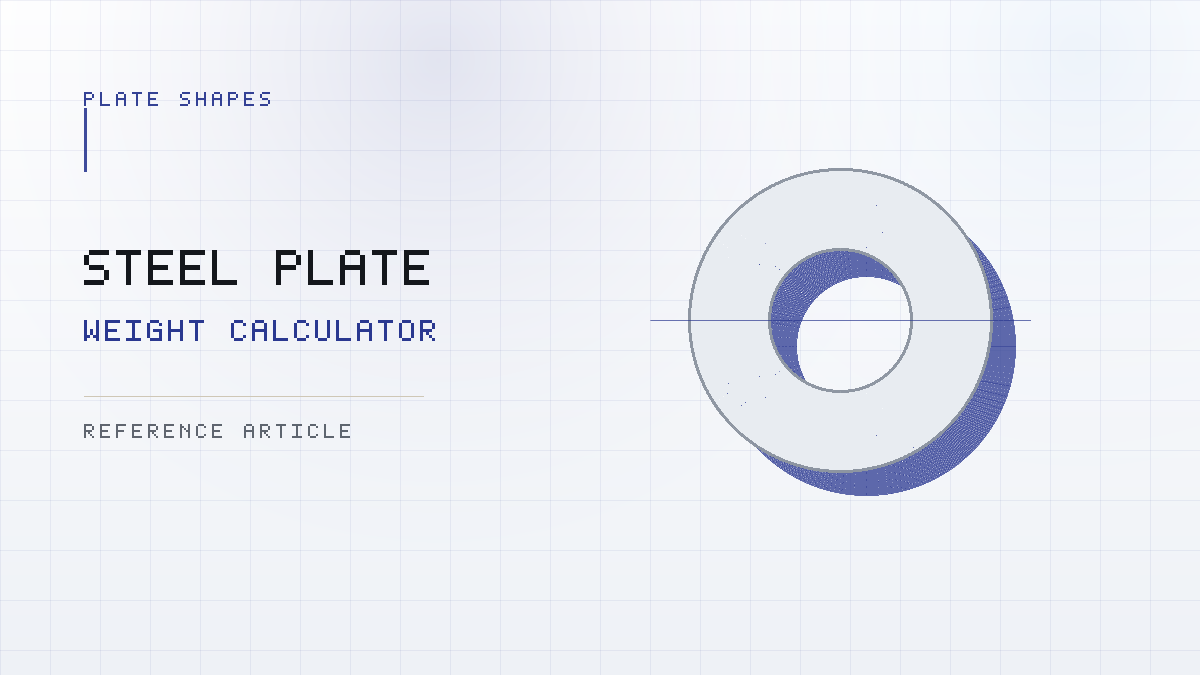
Triangular Plate Weight: Formula & Worked Examples
½ × base × height × t × ρ
Triangular plate weight starts with half the base times the perpendicular height. The formula, three-side drawings, and why the sloped edge is not it.
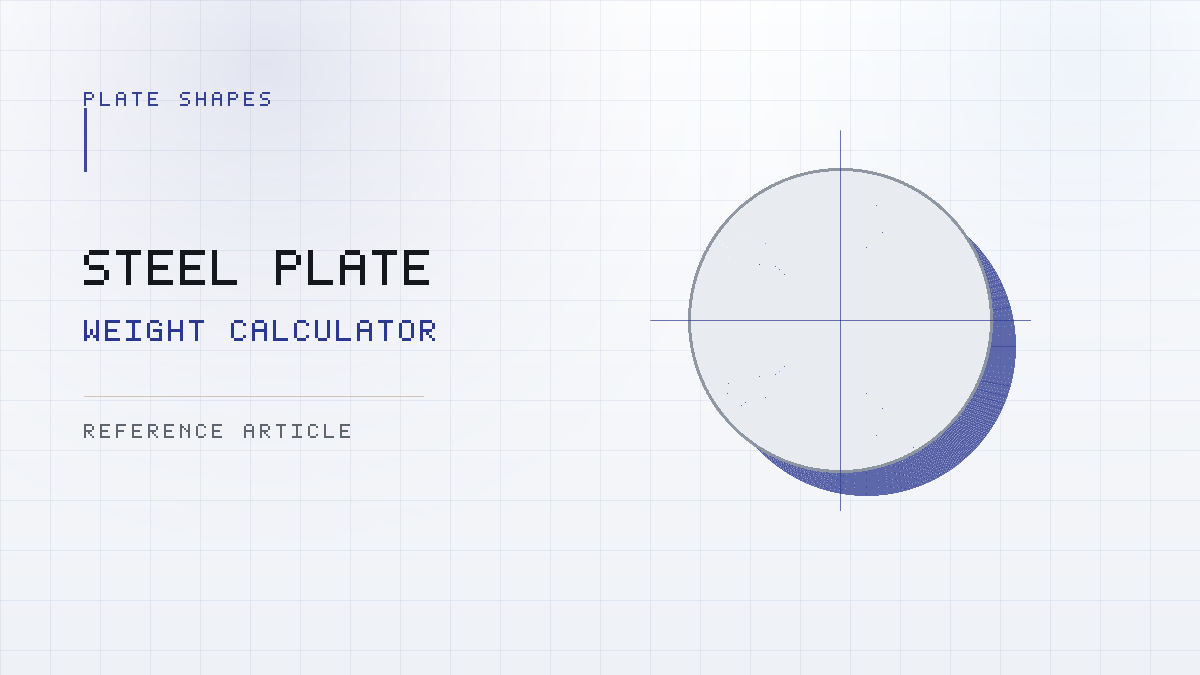
Ring & Annulus Plate Weight Explained
outer circle − inner circle
Annulus plate weight is the outer circle minus the inner circle, not the gap between two diameters. The correct subtraction, with a worked ring example.
Work Out Your Plate Weight
Enter length, width and thickness, pick the grade, and read the total. Discs, rings and triangles too, in millimetres or inches.