Base × height
Triangular Plate Weight: Formula & Worked Examples
½ × base × height × t × ρ
Triangular plate weight starts with half the base times the perpendicular height. The formula, three-side drawings, and why the sloped edge is not it.
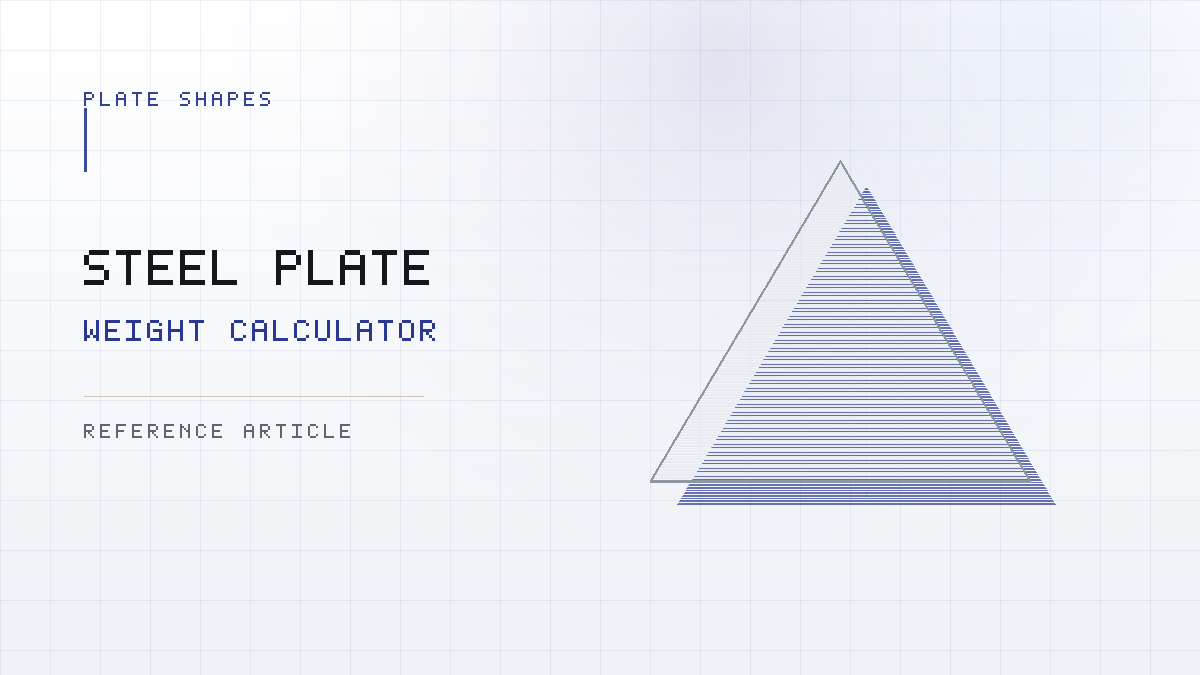
Triangular plate weight comes from the area of the triangular face, which is half the base multiplied by the perpendicular height. Multiply that area by thickness for volume, then by density for mass. The Steel Plate Weight Calculator does the same thing when you pick Triangular plate and fill in the base, height and thickness fields.
One detail decides whether your answer is right: the height in that formula is the perpendicular height, measured square to the base. On a right-angled gusset it is one of the sides you can see. On anything else it is not, and reaching for the sloped edge instead is the mistake this article is mostly about.
The formula for triangular plate weight
Same three-step chain as every other plate shape, with a different area term at the front:
A = ½ × b × h
V = A × t
m = V × ρ- b is the base, meaning whichever side you measure the height against
- h is the perpendicular height from that base to the opposite corner
- t is the plate thickness
- ρ is the material density
- m is the mass
The half is there because a triangle is exactly half of the rectangle that encloses it. A 1200 × 800 mm rectangle and a triangle on the same base and height differ by a factor of two and nothing else. That is a useful sanity check: work out the rectangle in your head, halve it, and see whether your answer is in the right area.
Any of the three sides can serve as the base. What matters is that the height you pair with it is measured from that same side, at a right angle.
Worked example: a 1200 × 800 mm gusset
A right-angled gusset plate, 1200 mm base, 800 mm height, 10 mm thick, mild steel at 7.85 g/cm³.
- Convert to one unit. b = 120 cm, h = 80 cm, t = 1.0 cm
- Face area. ½ × 120 × 80 = 4,800 cm²
- Volume. 4,800 × 1.0 = 4,800 cm³
- Mass. 4,800 × 7.85 = 37,680 g = 37.68 kg
The enclosing 1200 × 800 mm rectangle at the same thickness is 75.36 kg, which is exactly double. The check holds.
Working in metres gives the same result: ½ × 1.2 × 0.8 = 0.48 m², × 0.010 m = 0.0048 m³, × 7,850 kg/m³ = 37.68 kg.
The same gusset in imperial
Only the density figure changes. Take a 48 inch base, 30 inch height, 3/8 inch thick, in mild steel at 0.2836 lb/in³.
- Face area. ½ × 48 × 30 = 720 in²
- Volume. 720 × 0.375 = 270 in³
- Weight. 270 × 0.2836 = 76.6 lb
Two gussets from one rectangle
Here is the part that changes what you buy rather than what you calculate. A right-angled triangle is half a rectangle, so two of them fit that rectangle exactly, one rotated 180 degrees against the other.
Order a single 1200 × 800 mm gusset and the shop still has to start from a 1200 × 800 mm piece. You pay for 75.36 kg of plate and 37.68 kg walks out as a part, with half the material left as drop.
Order them in pairs and that drop disappears. The same 75.36 kg rectangle yields two finished gussets, so the material cost per part halves without anything about the part changing.
| What you order | Plate consumed | Finished weight | Drop |
|---|---|---|---|
| One gusset | 75.36 kg | 37.68 kg | 50.0% |
| Two gussets, nested | 75.36 kg | 75.36 kg | 0% |
Real nesting never reaches zero, because the cut takes a kerf and the cutter needs an edge margin. The point stands anyway: triangular parts are unusually sensitive to how they are ordered, and quoting a single gusset off its finished weight understates the material every time.
Check the gusset against the calculator
- Open the Steel Plate Weight Calculator.
- Set Blank geometry to Triangular plate.
- Enter Base 1200 mm.
- Enter Height 800 mm.
- Enter Thickness 10 mm.
- Select Mild Steel ASTM A36.
Success test: the total should be about 37.68 kg. If you see 75.36 kg, the half has gone missing somewhere and you have calculated a rectangle. If you see roughly 67.9 kg, the sloped edge has been entered in the height field.
When the drawing gives three sides instead
Fabrication drawings often dimension a triangular plate by its three edges and leave the height out entirely. The calculator asks for base and height, so you need to get from one to the other.
Heron’s formula turns three side lengths into an area without any angles:
s = (a + b + c) ÷ 2
A = √( s × (s − a) × (s − b) × (s − c) )- a, b, c are the three side lengths
- s is the semi-perimeter, which is just half the way round the triangle
- A is the face area
Take a plate with sides of 1200, 1000 and 800 mm, again 10 mm thick in mild steel.
- Semi-perimeter. s = (120 + 100 + 80) ÷ 2 = 150 cm
- The four terms. 150, 150 − 120 = 30, 150 − 100 = 50, 150 − 80 = 70
- Multiply. 150 × 30 × 50 × 70 = 15,750,000
- Square root. A = 3,968.63 cm²
- Volume and mass. 3,968.63 × 1.0 × 7.85 = 31,154 g = 31.15 kg
To put that into the calculator, convert the area back into a base and height pair. Rearranging A = ½ × b × h gives h = 2A ÷ b, so with the 1200 mm side as the base: h = (2 × 3,968.63) ÷ 120 = 66.14 cm, which is 661.4 mm.
Enter base 1200 mm and height 661.4 mm and you will get the same 31.15 kg. That perpendicular height is a real dimension of the plate, even though no one wrote it on the drawing.
Reading the height off a drawing
The safest habit is to decide which side is your base before looking for any other number, then ask what the perpendicular distance to the far corner is.
| What the drawing gives you | Can you calculate the area? | What to do |
|---|---|---|
| Base and perpendicular height | Yes | Use them directly |
| Three side lengths | Yes | Heron’s formula, then convert to base and height |
| Two sides and the angle between them | Yes | A = ½ × a × b × sin(C) |
| Base and one sloped side only | No | Ask for the missing dimension |
| Overall envelope size only | No | The envelope is a rectangle, not the plate |
That last pair matter. If the information genuinely is not there, no formula will invent it, and guessing a height produces an answer with no basis. Go back to the drawing office rather than filling in a plausible number.
For an obtuse triangle, the perpendicular height can land outside the triangle itself. The formula still works, and the height is still measured square to the base line extended. It just looks wrong on the page.
If the shape is obtuse enough that this bothers you, pick a different side as the base. Every triangle has three base and height pairs, all of which give the same area, so choose whichever one keeps the height inside the plate and the arithmetic easy to check. The three side lengths route works here too, and avoids the question entirely.
One habit worth building: write down which side you treated as the base next to your answer. On a cutting list of a dozen gussets with similar dimensions, that note is what lets someone else follow your working six weeks later without redoing it.
Where triangular plate calculations go wrong
Using the sloped edge as the height
On the worked example, the sloped edge is √(1200² + 800²) = 1,442 mm. Feeding that into the height field gives ½ × 120 × 144.2 = 8,653 cm² and a mass of 67.9 kg instead of 37.68 kg. That is 80% too heavy on a part that looked simple.
Any time your triangle answer comes out noticeably heavier than expected, check that field first.
Forgetting the half
Dropping the ½ turns the triangle into its enclosing rectangle and doubles the weight. It is an easy slip when you are working quickly through a cutting list of gussets, and the answer is always exactly 2× the correct one.
Mixing units between base and height
Base in millimetres and height in centimetres will not cancel. Each field in the calculator carries its own unit dropdown, so a drawing that gives base in inches and height in millimetres can be entered exactly as drawn rather than converted by hand.
Treating a trimmed corner as a triangle
Gussets frequently have a clipped corner, a notch for a weld, or a radius where two edges meet. Each of those removes a small area that the plain triangle formula still counts.
For a rough figure, ignore them. For a costed batch, take the clipped area off before you multiply by thickness. Once a plate has several such features, the guide to custom and irregular shapes covers splitting a profile into pieces you can measure, and the calculator’s Other shape geometry takes a face area directly.
Assuming the calculated figure is the delivered figure
Everything here works from drawing dimensions and a reference density. Plate thickness has a rolling tolerance, cut edges have a cutting tolerance, and neither appears in the arithmetic. Where an exact figure is needed, weigh the part.
Changing material changes only the last multiplication. The same gusset is 37.68 kg in mild steel, 38.06 kg in stainless 304 and 12.96 kg in aluminium 6061. The mild steel and stainless density comparison explains why the first two sit so close together.
Triangular plate FAQs
What is the formula for the weight of a triangular steel plate? Half the base times the perpendicular height gives the face area. Multiply that by the plate thickness for volume, then by the material density for mass.
Which side is the base of a triangle? Any of them. The base is simply whichever side you measure the perpendicular height against, so pick the one whose height you actually know.
How do I find the area if I only have the three side lengths? Use Heron’s formula: halve the perimeter to get s, then take the square root of s × (s − a) × (s − b) × (s − c). Convert that area into a base and height pair with h = 2A ÷ b if you want to enter it into the calculator.
Why is my triangular plate weight exactly double what I expected? The ½ has been left out, which turns the triangle into the rectangle around it. Halve your answer and check the formula.
Two numbers, carefully
Triangular plate weight is the least demanding calculation in this cluster, provided the height you use is measured square to the base. Confirm that one dimension and the rest is a short multiplication.
Once you have your figures, enter them into the Steel Plate Weight Calculator under Triangular plate and compare. If your hand calculation and the tool agree, the method will carry through the rest of the cutting list. For round blanks cut from the same sheet, the circular plate and disc guide covers that geometry.
Checkered Steel Plate Weight: Pattern Allowance, Formula & Chart
base plate + pattern mass
Checkered plate weight is the base plate plus the raised pattern. The pattern adds a fixed mass per square metre, not a fixed percentage of the base.
Hexagonal Plate Weight & Custom-Shape Calculations
measure, split, subtract
Hexagonal plate weight follows from the across-flats dimension, while irregular profiles get split or taken from CAD. The area for each, and how to use it.
Ring & Annulus Plate Weight Explained
outer circle − inner circle
Annulus plate weight is the outer circle minus the inner circle, not the gap between two diameters. The correct subtraction, with a worked ring example.
Work Out Your Plate Weight
Enter length, width and thickness, pick the grade, and read the total. Discs, rings and triangles too, in millimetres or inches.