Round plate
Circular Plate & Disc Weight: The Full Calculation Guide
π × r² × thickness × density
Circular plate weight comes from diameter, thickness and density. The formula, a worked example in metric and imperial, and the 4x error to avoid.
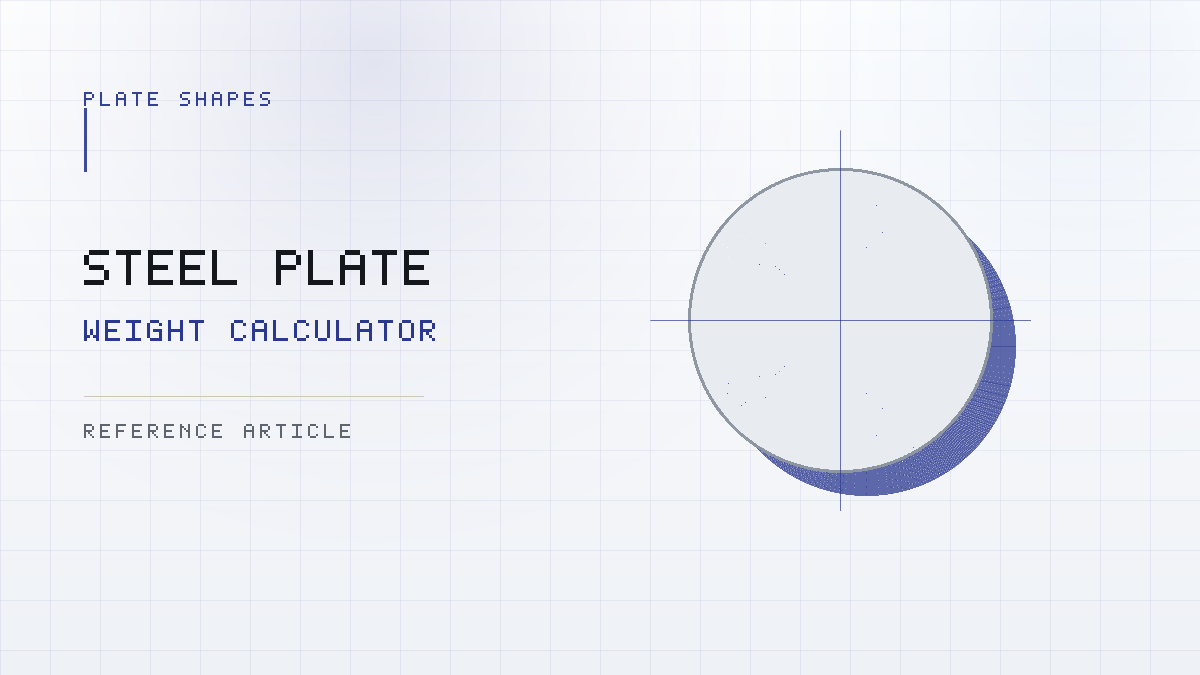
Circular plate weight depends on exactly three things: the diameter of the disc, its thickness, and the density of the material it is cut from. Work out the circular face area first, multiply by thickness to get volume, then multiply by density to get mass. If you want the answer before the explanation, put your figures into the Steel Plate Weight Calculator and pick Round disc as the blank geometry.
The rest of this guide is about getting the inputs right, because that is where round plate calculations usually go wrong. The arithmetic is short. Reading a diameter off a drawing and then squaring the wrong number is the part that costs you.
The formula for circular plate weight
Everything follows from one chain:
area × thickness = volume, then volume × density = mass
For a solid disc the area is the area of a circle:
A = π × r²          where r = diameter ÷ 2
V = A × t
m = V × ρ- A is the face area of the disc
- r is the radius, which is half the diameter
- t is the plate thickness
- V is the volume of the disc
- ρ (rho) is the material density
- m is the mass, which is what a supplier or a weighbridge will call the weight
Written out in one line using diameter instead of radius, that is:
m = (π ÷ 4) × D² × t × ρBoth forms give the same number. The second one is handy when your drawing only gives diameter, because it removes the step where people forget to halve it.
Keep your units in one system
The single most common source of a wrong answer is mixing units. Millimetres for diameter, metres for thickness and kg/m³ for density will not cancel correctly.
Pick one of these and stay in it:
| System | Diameter | Thickness | Density | Result |
|---|---|---|---|---|
| Metric (cm) | cm | cm | g/cm³ | grams |
| Metric (m) | m | m | kg/m³ | kilograms |
| Imperial | in | in | lb/in³ | pounds |
Mild steel is 7.85 g/cm³, which is the same number as 7,850 kg/m³ and 0.2836 lb/in³. Those are three ways of writing one density, not three different materials.
Worked example: an 800 mm disc in mild steel
A flame-cut blank, 800 mm diameter, 12 mm thick, in mild steel to ASTM A36.
- Halve the diameter. r = 800 ÷ 2 = 400 mm = 40 cm
- Face area. A = π × 40² = π × 1,600 = 5,026.55 cm²
- Convert thickness. t = 12 mm = 1.2 cm
- Volume. V = 5,026.55 × 1.2 = 6,031.86 cm³
- Density. ρ = 7.85 g/cm³ for mild steel
- Mass. m = 6,031.86 × 7.85 = 47,350 g = 47.35 kg
The same calculation in metres, if you prefer working there: π × 0.4² = 0.5027 m², × 0.012 m = 0.006032 m³, × 7,850 kg/m³ = 47.35 kg. Same disc, same answer.
The same job in imperial
Nothing about the method changes, only the units you stay inside. Take a 24 inch disc at 1/2 inch thick, again in mild steel.
- Radius. r = 24 ÷ 2 = 12 in
- Face area. A = π × 12² = 452.39 in²
- Volume. V = 452.39 × 0.5 = 226.19 in³
- Density. 0.2836 lb/in³, which is 7.85 g/cm³ expressed in imperial units
- Weight. 226.19 × 0.2836 = 64.2 lb
That density figure is worth knowing on sight. If you ever see a steel density quoted as 0.28 lb/in³ or 490 lb/ft³, those are the same reference value in different clothes, not competing numbers.
Check the disc against the calculator
This is the part worth doing once, slowly, so you trust the tool afterwards.
- Open the Steel Plate Weight Calculator.
- Set Blank geometry to Round disc.
- Enter Outer diameter 800 and set that field’s unit to mm.
- Enter Thickness 12, also in mm.
- Choose Mild Steel ASTM A36 from the material list.
- Read the total.
Success test: the calculator should return about 47.35 kg. A difference in the last decimal place is rounding and does not matter. A result of 189 kg or 11.8 kg does matter, and both have a specific cause covered below.
Each dimension has its own unit dropdown, so if your drawing gives diameter in inches and thickness in millimetres you can enter them exactly as drawn instead of converting by hand first.
Why the same disc weighs different amounts
Diameter and thickness fix the volume. After that, density alone decides the mass. That is the whole reason the material field exists.
Take the 800 × 12 mm disc from above, at 6,031.86 cm³, and change nothing but the material:
| Material | Density (g/cm³) | Disc mass |
|---|---|---|
| Aluminium 6061 | 2.70 | 16.29 kg |
| Mild steel ASTM A36 | 7.85 | 47.35 kg |
| Stainless steel 304 / 304L | 7.93 | 47.83 kg |
| Copper C110 | 8.96 | 54.05 kg |
Two things stand out. Aluminium is roughly a third of the steel figure, which is a large enough gap to change how a blank gets handled and shipped. Stainless is about 1% heavier than mild steel, which is far smaller than most people expect. If you are choosing between those two, the density comparison between mild steel and stainless goes into why the gap is so narrow. For the aluminium side, the aluminium plate weight guide covers how much the alloy actually shifts the number.
Density values like these are reference figures suitable for estimating. They are not guarantees about a specific heat of steel.
The disc you cut and the plate you pay for
Estimators get caught out by a gap that has nothing to do with the formula. You calculate the disc, but the mill invoices you for the rectangle it came out of.
A circle always fills exactly π ÷ 4 of the square that encloses it, which is 78.54%. The other 21.46% is drop. That ratio is fixed geometry, so it holds for any diameter and any material.
For the 800 mm disc, that means:
| Item | Calculation | Mass |
|---|---|---|
| 800 × 800 mm square blank, 12 mm | 80 × 80 × 1.2 × 7.85 | 60.29 kg |
| Finished 800 mm disc | π × 40² × 1.2 × 7.85 | 47.35 kg |
| Offcut | difference | 12.94 kg |
Whether the drop is a cost or a recoverable asset depends on your yard, but the two numbers answer different questions. Use the disc weight for handling, lifting and transport of the finished part. Use the blank weight when you are working out what the material actually costs you.
Nesting several discs from one sheet improves on that 78.54% figure, though never to 100%. If you are pricing a full nest rather than a single blank, take the area from your nesting software and enter it under the calculator’s Other shape geometry instead of calculating disc by disc.
Where round plate calculations go wrong
Squaring the diameter instead of the radius
This is the big one, and it is always wrong by exactly four times. Using D = 800 mm in place of r = 400 mm gives an area of 20,106 cm² instead of 5,027 cm², and a mass of 189.4 kg instead of 47.35 kg.
If your answer is suspiciously close to 4× what you expected, this is almost certainly why. The (π ÷ 4) × D² form of the formula exists to make this mistake harder.
Treating a ring as a solid disc
A disc with a hole in it is not a disc. If the centre is removed, you are calculating an annulus, and the missing material has to come out of the area before you multiply by thickness.
Using outside diameter alone always overestimates. On a 800 mm blank with a 400 mm bore, the hole is a quarter of the face area, so the solid-disc figure is 33% heavier than the real ring. The ring and annulus guide has the subtraction worked through properly, including why you cannot just subtract the diameters.
Small holes and cut-outs
Bolt holes, lifting holes and pockets all remove material. Whether that matters depends on what the number is for.
Put a number on it before deciding. Eight 22 mm bolt holes in the 800 mm disc remove 8 × π × 1.1² = 30.4 cm² of face area, which is 0.6% of the disc. That is 0.29 kg off 47.35 kg, so the drilled disc lands at about 47.06 kg.
For a transport estimate, ignore it. For a costing exercise where you are paying per kilogram across a few hundred parts, or a lifting plan where the plate sits close to a rated limit, take it off. The arithmetic is the same as for a ring: work out the hole area, subtract it from the face area, then carry on as normal.
Nominal dimensions are not measured dimensions
The calculation uses the numbers on the drawing. The plate in the yard has a rolling tolerance on thickness, and a cut disc has a kerf and a cutting tolerance on diameter.
Thickness matters more than diameter here, because mass scales directly with it. A 12 mm plate running at the top of its thickness tolerance produces a heavier disc than the drawing suggests, and no amount of care with π will find that difference. If you need the real figure rather than the estimated one, weigh it or work from the mill certificate.
Confusing mass and weight
In everyday estimating the two words get used interchangeably, and for buying steel that is fine. The calculator returns mass, expressed in kilograms, pounds or tonnes.
The distinction only starts to matter in an engineering context where force is what you actually need, such as a lifting calculation signed off by a competent person. A calculated plate mass is an input to that work, never a substitute for it, and it says nothing at all about whether the disc is strong enough for its job.
When a manual calculation stops being the right tool
A single disc is quick to do by hand. A cutting list of forty discs across three thicknesses and two materials is not, and hand arithmetic across that many rows is where transcription errors creep in.
The other case is a disc that has stopped being circular in any useful way: a segment, a disc with a flat, a plate with a large irregular cut-out. Once the profile needs breaking into pieces, the guide to hexagonal and custom shapes covers the decomposition approach, and the calculator’s Other shape geometry lets you enter a face area straight from CAD instead.
Circular plate weight FAQs
Do I need the radius or the diameter to calculate circular plate weight? Either works, as long as the formula matches. With radius use π × r². With diameter use (π ÷ 4) × D². Drawings usually give diameter, so halve it before squaring, or use the diameter form.
How do I calculate the weight of a circular plate with a hole in the middle? Work out the area of the outer circle, work out the area of the hole, and subtract one from the other before multiplying by thickness and density. Never subtract the diameters and then square the result.
Does the calculator give the exact weight of my plate? It gives a calculated estimate from the dimensions and density you enter. Actual delivered weight can differ because of thickness tolerance, cutting tolerance and grade variation. For anything contractual, use a weighed figure or the material certificate.
What density should I use for a steel disc? 7.85 g/cm³ is the standard reference value for carbon and mild steel and is what most estimating work uses. Stainless grades sit between roughly 7.70 and 7.98 g/cm³ depending on the family, so pick the specific grade if you need the tighter number.
Why is my calculated weight exactly four times too high? You almost certainly squared the diameter in a formula that expects the radius. Halve the diameter first, or switch to the (π ÷ 4) × D² version.
Before you cut
Get the three inputs right and circular plate weight is a two-line calculation: halve the diameter, square it, and let thickness and density do the rest. Get the radius wrong and everything downstream is wrong with it.
When you have your numbers, run them through the Steel Plate Weight Calculator with Round disc selected and compare against your own working. If the two agree, you can trust the method on the next forty discs as well.
Checkered Steel Plate Weight: Pattern Allowance, Formula & Chart
base plate + pattern mass
Checkered plate weight is the base plate plus the raised pattern. The pattern adds a fixed mass per square metre, not a fixed percentage of the base.
Hexagonal Plate Weight & Custom-Shape Calculations
measure, split, subtract
Hexagonal plate weight follows from the across-flats dimension, while irregular profiles get split or taken from CAD. The area for each, and how to use it.
Triangular Plate Weight: Formula & Worked Examples
½ × base × height × t × ρ
Triangular plate weight starts with half the base times the perpendicular height. The formula, three-side drawings, and why the sloped edge is not it.
Work Out Your Plate Weight
Enter length, width and thickness, pick the grade, and read the total. Discs, rings and triangles too, in millimetres or inches.